
Health Insurance Terms for Open Enrollment
This document provides definitions of key health insurance terms essential for understanding and making informed decisions during the open enrollment period.
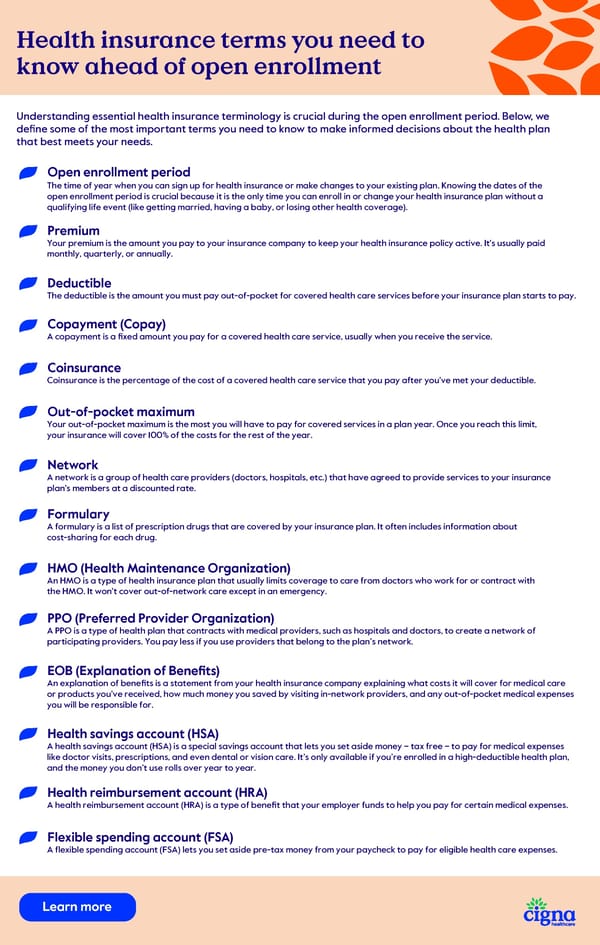
Health insurance terms you need to know ahead of open enrollment Understanding essential health insurance terminology is crucial during the open enrollment period. Below, we define some of the most important terms you need to know to make informed decisions about the health plan that best meets your needs. Open enrollment period The time of year when you can sign up for health insurance or make changes to your existing plan. Knowing the dates of the open enrollment period is crucial because it is the only time you can enroll in or change your health insurance plan without a qualifying life event (like getting married, having a baby, or losing other health coverage). Premium Your premium is the amount you pay to your insurance company to keep your health insurance policy active. It's usually paid monthly, quarterly, or annually. Deductible The deductible is the amount you must pay out-of-pocket for covered health care services before your insurance plan starts to pay. Copayment (Copay) A copayment is a fixed amount you pay for a covered health care service, usually when you receive the service. Coinsurance Coinsurance is the percentage of the cost of a covered health care service that you pay after you've met your deductible. Out-of-pocket maximum Your out-of-pocket maximum is the most you will have to pay for covered services in a plan year. Once you reach this limit, your insurance will cover 100% of the costs for the rest of the year. Network A network is a group of health care providers (doctors, hospitals, etc.) that have agreed to provide services to your insurance plan's members at a discounted rate. 3 Formulary A formulary is a list of prescription drugs that are covered by your insurance plan. It often includes information about cost-sharing for each drug. HMO (Health Maintenance Organization) An HMO is a type of health insurance plan that usually limits coverage to care from doctors who work for or contract with the HMO. It won't cover out-of-network care except in an emergency. PPO (Preferred Provider Organization) A PPO is a type of health plan that contracts with medical providers, such as hospitals and doctors, to create a network of participating providers. You pay less if you use providers that belong to the plan’s network. 3 EOB (Explanation of Benefits) An explanation of benefits is a statement from your health insurance company explaining what costs it will cover for medical care or products you've received, how much money you saved by visiting in-network providers, and any out-of-pocket medical expenses you will be responsible for. Health savings account (HSA) A health savings account (HSA) is a special savings account that lets you set aside money – tax free – to pay for medical expenses like doctor visits, prescriptions, and even dental or vision care. It’s only available if you’re enrolled in a high-deductible health plan, and the money you don’t use rolls over year to year. Health reimbursement account (HRA) A health reimbursement account (HRA) is a type of benefit that your employer funds to help you pay for certain medical expenses. Flexible spending account (FSA) A flexible spending account (FSA) lets you set aside pre-tax money from your paycheck to pay for eligible health care expenses. Learn more
 Health Insurance Terms for Open Enrollment